settle one per session, starting with #1. each answer goes to the decisions log.
- words: what are the higher-level names for what every domain names differently? now a cube of its own (11-words.md); the concepts are variables until named. working words for now: row, column, option (X, Y, Z).
- real cube vs mental cube: may a piece show on several faces, and may it be twisted?
- must faces and positions mean something everywhere (mosaic)?
- is a question part of the cube, or only a hint?
- list or grouped when a cube opens?
- depth: no base case everywhere, or capped per project?
- three dimensions on a phone: colour, depth slider or small multiples? (try colour first.)
- two visual dialects: one system with two themes, or two?
- navigation is a kind of the design: what are its values, and where does zoom out go when nothing is behind you? studied 2026-10-29, see below.
- a cube is both a thing and a way of looking: where do the two pull apart, and does that explain the tensions below? studied 2026-10-29, see below.
- cube design is both a door and a key: when is it which, and is it the thing and the way of looking again? studied 2026-10-29, see below.
- A has many B, and B has many A: which is inside which, and how does zooming in not walk in a circle? kept as a concrete example 2026-10-29, see below. navigation settled the same day: principle 17 (two journeys, the other side only from afar); the rest stays open.
parked: AI helping the person work on a cube (suggest pieces, notice what is the same, place values; selim, 2026-10-29, a side note for now) · will people use a nameless colour-only dimension · how a 1×1×1 grows without pressure to fill · zoom on a card or as a gesture · kitchen as the next real cube · a shared cube component and backend module.
navigation, a kind of the design (#9, studied 2026-10-29)
selim, 2026-10-29: zoom out is the move he keeps using to come back once he is done with something, even where zoom in does not always fit. then: "navigation, it is a dimension of the design". if the design is a cube, navigation is one of its kinds (a column), and the ways of getting around are its values.
three distances, kept apart
- the kind: navigation, the question "how do you get from here to somewhere else?"
- its values: the ways. seen so far: zoom in, zoom out, back (the way you came), side by side (tabs, a bottom bar), turning (rotate, a swipe), arriving from outside (a link, a push, a shortcut), switching to another app. each value is a piece that can open as a cube of its own (no base case), and more will be found.
- how a way is made in one environment: URLs, a back button, a gesture handler. these are implementation ideas: collected below, never part of the design, because another environment may have no URL and no back button.
zoom out, at the abstract level
zoom out goes one step further out from where you are. where you are is enough to know where that is; how you got there is not needed. that is the difference from back: back is time (the way you came), zoom out is distance (one level further out). it also answers selim's case: arriving from outside, with nothing behind you, zoom out still has somewhere to go.
on a phone: zoom in spreads two fingers apart, zoom out brings them together (say, thumb at one corner and index finger at the opposite corner, closing along the diagonal).
mosaic as levels today (the example the question came from; from SUB_APPS and the routes in lang-app-fe):
| level | what it is | its pieces |
|---|---|---|
| 0 | mosaic, the home cube | the sub-apps (12) |
| 1 | a sub-app (kitchen) | its tabs (home, in season, rotation, ...) |
| 2 | a tab (in season) | what it shows (ingredients, recipes, sessions, ...) |
| 3 | one thing (an ingredient, a recipe, a report) | its parts (forms, products, what was eaten) |
| inside a screen | a circle in a todarch lens, a year in finance |
an edit or new form is not a level: it is a move (collect, distinguish) on its piece. a filter or a grouping is a look (rotate), not a level.
the open choices
- back and zoom out: one way or two? in cubes they are one ("back is always one step out"); in 04-moves.md they are two rows.
- a tab's step out: its sub-app's home tab, or the sub-app itself? kitchen home is a tab, a sibling of in season, not above it.
- a piece in several cubes. an ingredient is in in season, rotation, the catalog and a recipe at once (no axis is the master), so "one level higher" is not one place.
- a one-piece cube (a sub-app with one tab): skipped going in, so skipped going out?
- where zoom out works. everywhere, or only where it does not fight something else on the screen (a chart, the system's own zoom)? settled 2026-10-30 by principle 25: every screen inside another, with the back arrow kept as the backup; a screen whose own content needs two fingers is an exception considered when it comes.
recommended (not decided): zoom out works everywhere and is one step out by place, never by history. a tab steps out to its sub-app, not to its home tab (kitchen › in season zooms out to kitchen). a one-piece cube is skipped both ways. a piece in several cubes steps out to the cube you came in through when that is one of its cubes, otherwise to its own home: the way you came only chooses among the piece's cubes, never leads where the piece is not. a form steps out to its piece and keeps what was typed; a look is kept when zooming out and back in. zoom in stays a tap where spreading fingers does not fit.
implementation ideas (collected, for when a project needs them)
- web (mosaic): work out one step out from the address alone, an
outOf(url)like the cubes app's, built fromSUB_APPSand route data, so a deep link (a push to/ai-journal/reports/<id>) zooms out like a walked path: a report › reports › AI journal › mosaic. - web (mosaic): the sub-app level has no address today (it exists only while the home cube is zoomed into it); give it one (
/?in=kitchenor/kitchen) so it can be landed on. - web: the system back stays the way you came; the header's ‹, escape and the closing fingers are one step out.
- mosaic itself may later be a piece of selim's own cube beside cubes and anlat: as far out as anything is known.
a thing and a way of looking (#10, studied 2026-10-29)
selim, 2026-10-29: "a cube is both a thing, like when we say a piece, but a cube is also a way of looking." one piece with its colours is static: it stays put and you cannot do much with it. a big cube with many dimensions is something you look with: you turn it, you make moves, and then you are looking. "at places maybe we are running into some issues" because of it: navigation acts and moves, while elsewhere we talk about pieces, which are static.
a study: the sentence is kept as it is and grown, not settled. below, the places it seems to explain, each marked as seen or as a guess.
where the split seems to explain a tension
- the moves split on it (seen). collect, notice and distinguish change the thing (a piece, a kind, a value is added); rotate and zoom change the looking (nothing is added, the same pieces are seen another way). that is the "moves that look, moves that grow" finding, said in the sentence's words. it also shows a contradiction already in the repo: 04-moves.md puts distinguish with the moves that look, while adding a value changes the thing. kept as a finding.
- navigation is the looking side (seen). every value of navigation (#9) changes where you look from and never the cube. that is why navigation felt like a kind of the design and still did not fit beside the pieces: the pieces are the thing, the ways of getting around are the looking.
- back fits neither, because it belongs to the one who looks (guess). zoom out goes by place, which is the thing's (where a piece sits); back goes by history, which is the looker's (the way you came). so maybe there are three: the thing, the way of looking, and the one looking. not placed yet.
- zoom turns one into the other (guess). a closed piece is a thing; opened, it becomes a cube you look through; stepping out, a cube you were looking through becomes a thing again, a piece of something larger. "no base case" may be this switch, and "flat then fold" its picture: flat is a thing only, folded has a way of looking inside.
- the thinnest word is the looking (seen). in the ten domains of 11-words.md,
?0to?4name the thing and only?5names the looking, and?5is the variable most domains have no word for (SET, music). domains name what things are much more than how they are looked at. - two sorts of empty (guess). "impossible by build" (a rubik's centre has one sticker) is a fact about the thing; "not known yet" is a fact about the looking: where attention has not been. that may be why the words did not tell them apart.
- face at two distances (guess). a piece's face (its sticker) is the thing; the cube's face (turned to one way its pieces are alike) is the looking. the rubik's word holds both, which may be why it fits the cubes app.
- two kinds of turn (seen). a rubik's twist moves the pieces and changes the thing; rotate in cube design leaves every piece where it is and changes the look. mosaic's home cube is turned like the first: it is a thing you move, with no kinds to regroup by (its
?2is "none: fixed by code" in the words table). - size (selim's own example). A 1×1×1, or one piece, is mostly a thing; with more pieces and kinds it becomes something to look with. maybe the "how a 1×1×1 grows" question (parked) is how a thing becomes a way of looking.
where it already shows
- principle 2, "the cube is the viewfinder, not the data", picks the looking side; cubes and anlat store cubes as things (a cubes table, a cube that grows). the sentence says both are true.
- look (
?5) is client state, never stored: the looking is never kept, the thing is. - 0.2 was released as "the way of looking"; the philosophy says "the subject was never the point, the way of looking was". the sentence brings the thing back beside it.
- principle 14 says cube design is "a design and an understanding at the same time": the same pair, said about cube design itself. as a thing it is files,
cube.jsonand the cube design cube in cubes; as a way of looking it is the principles used on itself.
Open
- is the one who looks a third side (back, history, "yours" against the library)?
- does every kind of the design sit on one side, or is that a kind of its own ("thing or looking")?
- should the moves table be grouped by it?
a door and a key (#11, studied 2026-10-29)
selim, 2026-10-29, after talking to a colleague: "this cube design and this whole approach, it is both a door and a key. sometimes it becomes a door that I cannot move forward, but then it becomes a key that I open that door." a study, kept as it is; each place is marked seen or a guess.
where it shows
- born from a door (seen). cube design came out of the "cube problem" that kept appearing in google keep, a notion framework, every mosaic app and anlat: a door in each of them. the same shape became the approach that opens them. the key is cut from the door.
- a closed piece is a door (seen). the philosophy already says "a thing we do not understand yet is a piece we have not opened yet". zoom in is the key; no base case means every opened door shows more doors.
- findings are doors (seen). each finding is something that did not fit; placing it (a piece of a question, a cube of its own, a new axis) is turning the key. that is why findings are kept and not fixed away: a door fixed away is never opened.
- rules turn into doors (seen). held as a rule, the design blocked the work more than once on one day: the face drawn as a table was rejected, one word set for every project gave way to each project's own words, "pinch" was heard opposite ways. each time the block itself showed the next step.
- door and key may be thing and looking (guess). held still, as a thing (a rule, a fixed shape, a file), cube design stops you; turned, as a way of looking, it opens. then door and key are #10 felt from the inside, over time: not two sides of the cube but the moment one becomes the other.
- it depends on the one holding it (guess). the same cube is a door to one person and a key to another, or to the same person an hour later. that fits the third side #10 found: the one looking.
- empty cells are doors not tried yet (guess). "not known yet" is a door nobody has tried; "impossible by build" is a wall, not a door. a piece of the two sorts of empty.
Open
- can the design show when it has become a door (a sign, a pale tile, a finding), so it is not felt only as being stuck?
- is the turn from door to key a move (like notice), or something the design cannot make happen, only leave room for?
A has many B, and B has many A (#12, kept 2026-10-29)
selim, 2026-10-29, from a talk with a friend, kept on the side as a concrete example for the cubes app. a university has professors, so the university is a cube and its professors are pieces (or a column). the friend: a university cannot exist without professors. selim: it can, if every professor is fired it is still officially a university. both agreed a professor can exist without a university in some way. then: start from a firm of professors who work like consultants, with several universities or none. now a professor has many universities, and a university has many professors. which is inside which? the same in cubes: a mountain has continents (a mountain can sit on two), and a continent has mountains. "A has many b's, but a B can also have many a's. and this is the loop."
the loop, seen in cubes today (the mechanism is seen in the code; the mountains are selim's example). a value may be a piece of another cube (pieceId, "the same piece, in another cube"), and the value screen offers that piece as a tile to zoom into. so: mountains › everest › continent › asia, zoom in, and asia is a piece of continents; asia › mountains › everest, zoom in, and everest is a piece of mountains again. every step was a zoom in, yet you are back where you started, at the same distance. zoom out, which goes by place, then leads out of the cube you landed in, not the way you came. zoom stops being a change of distance: four steps in, no closer.
how anlat escapes it (seen, in anlat's code and docs/discovery.md, round 4). anlat has the same shape (a story has many feelings, a feeling is on many stories) and no loop, because it has two journeys, not one way of going around:
- journey A, from one thing in: a story › its column (duygu) › its values. at the far end a value is a leaf: a tap puts it on the story or takes it off. it is a move, not a door, so the journey ends there.
- journey B, from afar: küpün › a column from afar (duygular) › a value from afar (kırgınlık) › the stories that carry it › one story. the story opened is journey a's start, so looking "comes back around" on purpose, and nothing goes deeper than the value.
- B crosses into A (from a value to a story); a never crosses into B from inside a value. the circle exists but is walked one way, once, and back goes the way you came.
what it seems to say: the many-to-many is not broken, the two directions are given two different distances. one side is the thing you are in (close up), the other side is a way of looking at many of them (from afar). cubes has the from-afar screens since the same day (/k/..., a kind from afar), but the value's "same piece in another cube" tile is still a door from close up, which is where the circle closes.
the DDD parallel (selim's link). in domain-driven design an aggregate owns what is inside it and holds other aggregates only by reference (their identity), never inside; a many-to-many between two aggregates is never containment on both sides. often the link itself becomes a thing of its own: not "a university has professors" but an appointment (this professor at this university, from when to when), which may outlive or precede both. in cube design words, a guess: containment is "is inside" (zoom), a reference is a value (a placement), and the appointment is a placement that has become a piece. cubes already has the reference (a value that is a piece elsewhere); what it lacks is the rule that following a reference is not zooming in.
what the example shows (each a guess unless marked)
- inside depends on where you start (selim's own example). from the university, professors are inside; from the consulting firm, universities are something a professor has. neither is the master (principle 1), so "which is inside which" is not a fact about the thing but about the one looking, or about the starting cube. a piece of #10 (the one looking).
- existing without the other (selim and his friend). a university with no professors is a cube with an empty column, still a cube: "empty is the point". a professor with no university is a piece with "not known yet" on that face. neither has to be inside the other to exist.
- two kinds of going somewhere. zoom in goes inside (distance); following a link goes across, to the same piece seen in another cube (no change of distance). today both are drawn as a tap on a tile, so going across feels like going in. a piece of #9 (navigation has more values than zoom).
- a piece in several cubes, again (seen). #9 choice 3 and the finding "a piece can only be inside one cube" are the same knot from the other side.
- the link may be a piece. the appointment, a mountain's place on a continent (how much of it, which side): when a link starts to carry its own colours, it is a third cube, not a column of either.
settled the same day (selim, 2026-10-29: "I want that to be a rule"): anlat's two journeys become principle 17 in 03-principles.md, and cubes takes it. close up, a value is where the journey ends; the other side is seen only from afar, by turning the whole cube to a face. selim asked not to bring in another word for it (such as "base case"). named later that day, for now: journey one (from one piece in, close up; anlat's journey A) and journey many (the whole cube from afar; anlat's journey B).
still open
- is going across (to the same piece in another cube) a value of navigation of its own, drawn and named differently from zoom in? under principle 17 it is not offered close up any more.
- when does a link become a piece of its own (the appointment)?
- is "which is inside which" a dial (each project picks), or always the one looking's choice?
language as a piece (#13, opened 2026-10-30)
selim, 2026-10-30, introducing principle 23 as a high-level concept "that we will fill in the details". the first way of doing it, in anlat: every line on screen left the code for a table of its own (notion "lines": one row per wording, turkish and english side by side, a tick for the one in use; the app ships a copy of the ones in use, so the first moment and the trial need nothing). what is still to be filled in:
- what a line's wordings are on: the word sets anlat already has (an, hikâye, küp) are one face; tone, audience (older readers, a friend trying the beta) and language could be others. is a wording a piece with colours on these faces?
- how wordings are compared and chosen: by selim alone, by trying them on people (a persona test, a beta), by who the reader is?
- an interface to play with the lines (seeing a screen with another wording at once), later; notion is the first one.
- is a line's key the right shape? it names where a line is used (
speak.done), which is the code's view; the language's own view may group lines by what they do (invite, thank, explain, ask). - does the same hold for the data an app brings itself (offered columns and answers, a seeded library)? principle 22 already treats it as the app's own words.
findings
- one face, two sorts of piece and two own boxes (2026-10-30, mosaic's todarch cube, selim: "i think it is a violation… we need to study this"; picture:
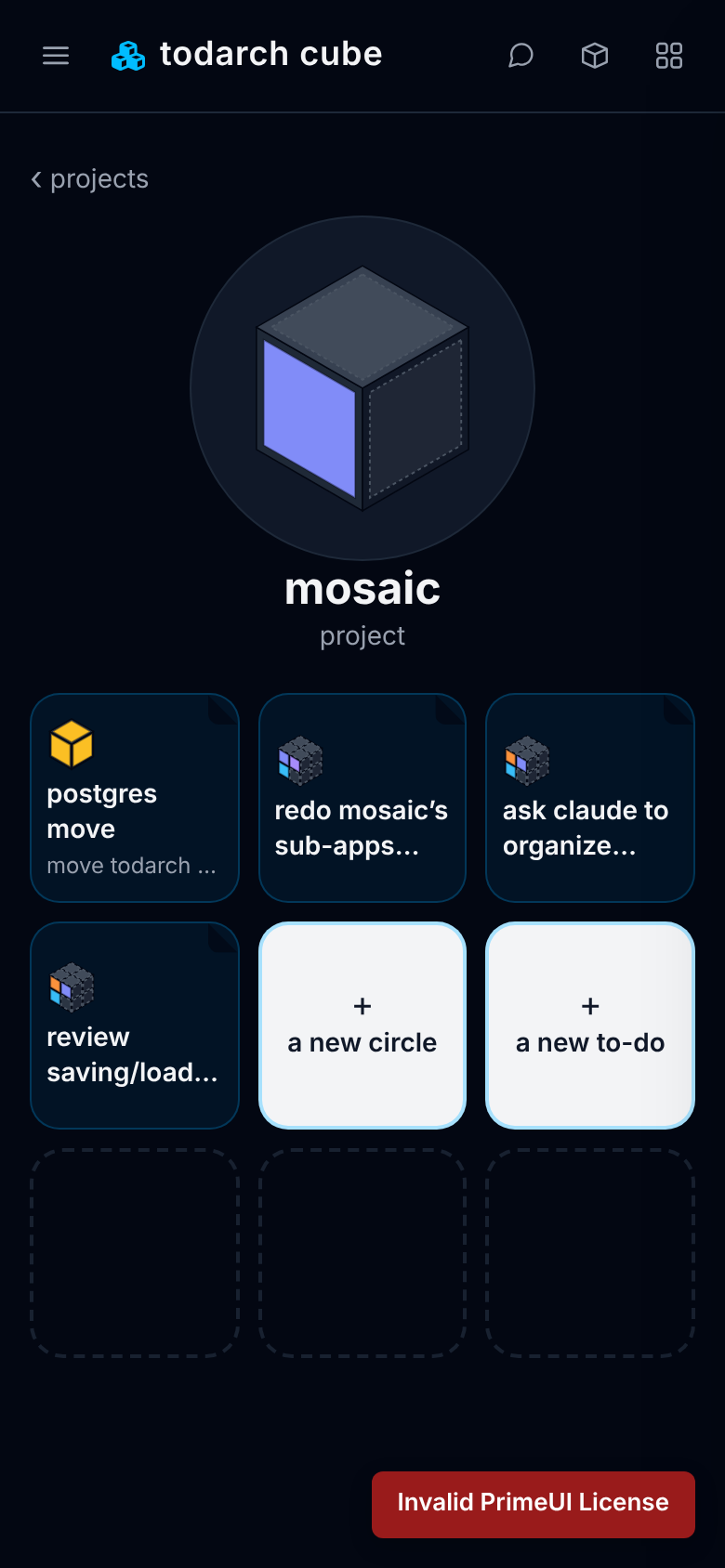 ). opening the circle mosaic (projects › mosaic) shows the circle inside it (postgres move), then three to-dos placed in mosaic itself, then two own boxes: a new circle and a new to-do. it is the first screen in any cube app that offers two things to add. what looks wrong: one face lists two sorts of thing (a way of grouping and the things grouped), and asks the person to choose which sort to grow it by. how we got here: in todarch a circle is two things at once, a value of its lens (a colour) and a box that holds both circles and to-dos; the cube copied the box as it is. selim's way out: a level holds one sort only. mosaic's own to-dos would sit in a circle of their own inside mosaic (named mosaic, or what they are about), so mosaic shows only circles and one own box, a new circle, and a circle with nothing inside shows its to-dos and one own box, a new to-do. still to study: what happens to a circle's to-dos when its first circle inside is made (do they move into a circle of their own by themselves?), whether todarch's anchor (the to-do a circle grew out of) is that circle, and whether "one face holds one sort of piece, with one own box" is a principle (it reads as 16, every piece has the same shape, plus decision 22, your own box). a piece of "a kind is a piece of the cube it groups" (two sorts of piece on one face) and of "a lens is a face, and its circles nest"; not placed yet. the screen stays as it is until this is placed.
- cube design has no way of loading yet (2026-10-30, mosaic's todarch cube, selim). while it loads, the todarch cube shows mosaic's skeleton: grey cards in a list, a shape cube design never uses. a cube app wants its own loading look (the square's outlines, the small cube drawing itself?). not designed yet; parked as a todarch to-do.
- numbers on a cube that is about numbers (2026-10-30, mosaic's agents usage). cubes decided nothing is counted, and principle 8 says no scores. the usage cube is a measurement: its values say their share of the effective tokens ("notion 24%") as a figure under the name, the most used first, and a report says its tokens. a share is what the value is, not a score of how well it went: no budget, no red, no warning. a piece of principle 8 and of the cubes decision on counts; not placed yet.
- from afar a value opens nothing, yet a to-do app has to reach its to-dos (2026-10-30, mosaic's todarch cube). cubes made a colour seen from afar the end of the journey (opening it is parked). in the todarch cube, a value seen from afar (parked, weekly, a circle) names its first to-dos and a tap turns the to-dos face to that face, at that value: the names face turned, not a cube of its own, so zoom stays a change of distance. a piece of principle 17 and of the parked "opening a colour seen from afar"; not placed yet.
- a lens is a face, and its circles nest (2026-10-30, mosaic's todarch cube). todarch built lenses and circles before cube design had its words: a lens is a face and a circle a value, but circles hold circles (mosaic › postgres move). from afar the face shows a lens' own circles only; close up, on one to-do, every circle at every depth can be placed. two depths of one value; a piece of #6 (depth) and of "the same word at two distances".
collected as they appear, not fixed yet. each waits to be placed: a piece of an existing question, a question of its own, or a new axis.
letting go and hiding are close, and may be one move (2026-10-30, cubes, while building renaming; mockup https://claude.ai/artifact/Vh8tzKWzcpxfPGSxNAvANv). both fold a thing away and bring it back with one tap, and neither throws it away (18, 20). they differ in who and where: hiding is a look (what this viewer chooses to see, on one phone, the library's things too); letting go changes the cube itself (only yours, kept with the data, on every phone, "this is not part of my cube any more"). what is missing today: hiding does not travel between phones, and a cube of yours has no way to say "a mistake" or "a duplicate" except notion by hand. three ways: (a) one move, hide, kept with your data for yours and on the phone for the library's; (b) two moves, hide as a look and let go as a change, under two words; (c) hide everywhere, and let go only from hidden, for good but still kept. how i would place it: a piece of principle 20 (hide, never delete), asking whether a look and a change are two moves or one move kept in two places. not placed yet: waits for selim. placed 2026-10-30: selim chose (a), one move, hide; a piece of principle 20 (see 08-decisions.md).
anlat's cube names its faces as questions (2026-10-30, cubes, while giving every app a cube of its own). anlat's cube was made that morning with faces like nerede yaşar · lives in, ne kadar oturdu · how settled, ne için · what for, durum · status; principle 29 names a face by its answers in the plural (places, stages, uses, states), as cubes' own cube now does. the two app cubes share a shape but not its words. not renamed: anlat's words are its own (one vocabulary), and turkish may have its own plural answers. placing it: a piece of principle 29 (does it reach every language?), or a note for the anlat-cube skill.
language is a cube, and voice is one of its pieces (2026-10-30, anlat, selim 11:58; anlat R62,
docs/voices.mdthere). language became a piece of the design in the morning (23). by noon it opened: a line is said in a language (tr, en), with a word set (an, hikâye, küp) and in a voice, the way sentences are built and what the talk carries, even in one language. anlat now keeps two voices side by side: inviting ("istersen", "-ebilirsin") and the user's own (first person, no conditions, no permission, 28), chosen by the user among their preferences, each saying the same line its own way. selim: "we discovered language as a cube… because it was a piece of the application… and now we are realizing which piece it has." how i would place it: a piece of question 13 (the faces a wording sits on), now with three faces found; whether voice is one face or several (who speaks, mood, distance, length) is not known yet, and "voice" is a working name (selim also said persona and attitude). it also turns principle 28 from a rule into a voice: the user's own voice is offered, not imposed, which follows "principles serve, they do not rule".the versions face is a loop (2026-10-30, the website, after selim said the versions face "feels off"; study: https://claude.ai/artifact/YKceBC6tibZr7Nr8sAVP4S). the home of the newest version holds a versions face, which holds the newest version, which is the home again: zooming in on it lands where you started. it breaks 6 (zoom is a change of distance: in, you come out at the same distance), 17 (the loop two journeys are there to avoid) and 29 (a face holds the columns of its rows; versions are not something every piece has, they are what the whole cube is), and strains 16. a principle it may point to: a face holds only what its pieces have; what is about the whole cube is one level out, reached by zooming out. proposed placing: zoom out of cube design into a cube of its versions (faces: versions, days, stages), with no versions face and no /v/
/ alias for the newest; each version keeps its changes face. not placed yet: waits for selim. time is a face of cube design (2026-10-30, the website, violation 10). versions became a face beside pieces and layers. what it showed:
- the newest is both the whole and one of its parts. cube design at the top is version 0.3, and 0.3 is also a piece of versions. to keep zoom a change of distance, the newest is drawn twice (at the top and inside versions). is the whole always also the newest of its versions, and is that a loop principle 17 allows? not placed yet.
- a version is a cube of the same shape, not a value. inside versions each tile opens a whole cube (with its own pieces, layers, changes), unlike a value that opens the pieces holding it. so versions is a face whose pieces are cubes, the same as pieces whose pieces are files. a piece of #9 (navigation) and of 5 (no base case).
- changes compares two versions. new, grown and the same are found by setting a version beside the one before it: a kind made by comparison, not written by anyone. sameness first (3) at the level of versions.
- old versions keep their own words. 0.2 and 0.1 still write capitals (Layer, How settled, Cube Design), from before principle 22; frozen, so they stay (18). a reader going back in time sees the older look.
- the same piece across versions (principles in 0.2 and in 0.3) is now reached only from afar. if people miss going straight across, it may be a journey of its own; not placed yet.
a cube opens on its shape, not its rows (2026-10-30, selim, violation 9). the same mistake in anlat (moments), cubes (planets) and the cube design website: going into a cube showed its pieces, where its faces should be. as a principle it could read: going into a cube shows its shape first: the faces every piece has. the first face is the names its pieces are pointed to by (a word of its own when the cube's name and its pieces' name are the same word: violations › examples); the pieces are inside it. made principle 29 by selim the same day ("we should not repeat that mistake … at the moment it seems like it's a principle. we find out."), with the faces named by their answers in the plural. what building it showed:
- a text is a face too. why it feels wrong and how it could follow are columns of long text; inside them, every violation's text, one at a time. a picture is the same (violation 3 has none and stays pale).
- several values on one face. a violation breaks several principles and may be seen in several apps; a choice face holds one value, these hold many, and a piece sits under each of its values.
- the writing guide repeats the shape as a list. under the faces, "how a violation is written" lists the same fields as bullets. it is for whoever writes a violation, not for a reader; whether it belongs on the face is not placed yet.
- turning still has nothing to do. the swipe on the cube used to regroup the tiles; zooming into a face does that now, so the website has no turning. open as before.
a kind is a piece of the cube it groups (2026-10-30, cube design's website, violations 7 and 8). built at selim's ask: the violations face holds the violations and, beside them, "apps" and "what happened to it"; zooming into apps shows anlat, cubes, mosaic and cube design, and zooming into anlat its violations. what it showed while building:
- two sorts of piece on one face. a violation and "apps" sit side by side as siblings, but they are not alike: one is a thing, the other a way of looking at the things (open question 10). the folded corner (05-patterns.md) is what tells them apart for now. principle 16 says every piece has the same shape, and apps has no app. not placed yet. answered by selim the same day: the face was showing the rows. a cube opens on its shape (its columns), and the rows are inside its first column, the names (examples); then nothing on the face is a thing, every tile is a face, and 16 holds. violation 9.
- rotate lost its gesture. turning the cube (a swipe) regrouped the tiles; with kinds as pieces, zooming into a kind does the same job, so the site has no turning left. is rotate the same move as zooming into a kind, seen from afar (journey many, 17)? a piece of #9 (navigation) and of the moves.
- the pale values stay. inside apps, cubes and mosaic have no violation yet and keep their place pale (7). inside a pale value the face is empty and says "not known yet".
- the next piece, sideways. the ‹ › links to the previous and next piece at the bottom of every page were a way around nobody agreed on either, and were taken out with the arrows. whether going sideways is a move at all is not placed yet.
- a colour without a key. the violations still take the colour of their first kind (apps) with nothing on the face saying so. colour before vocabulary (4) says that is fine; whether a reader misses the key is not known yet.
who the principles serve (2026-10-30, violation 5): cube design says "the person" for the one using an app, but a maker uses it too and stands on both sides. user, person, the one looking (open question 10's third side)? not placed yet.
opening a colour seen from afar is parked (2026-10-30). in cubes, a colour of a face seen from afar (spices › parts › flower) opened onto the pieces with that colour, which looked like the cube again. selim: anlat never did this; the last thing reached is a colour, so it was removed for consistency and parked. the question it leaves: is "every piece with this colour" a cube of its own (principle 4, sameness makes a dimension) or only a look at the same cube? a piece of principle 17 and of #12; not placed yet.
faces that hold pieces want the plural (2026-10-30). selim: "part" reads as one thing, "parts" as the many pieces it holds, like names. a face named in the plural says it is a pile of pieces; a question in the singular ("which part is it?") stays its hint. a piece of #1 (words); a rule for anyone who names a face, the daily cube routine included.
a grid is always a complete square, and it zooms by itself (2026-10-30). selim: a cube's pieces sit in an n × n square, the smallest that holds them all (with your own box): 1, then 2 × 2, then 3 × 3; places not filled yet keep their outline, because something can still come there. one more piece than fits and the square zooms out one step; few pieces are seen close, many from afar (name and line, then the name, then only the colour), and a tap or a pinch goes closer. the square keeps its size, so on a desktop nothing moves. the grid becomes a face of the cube, which raises whether the cube on top should grow with it (side n) instead of by count (1, 8, 27). mockup: https://claude.ai/artifact/M1brv5zR5zsnJLxq4znY4C. a piece of principle 7 (zoom is distance) and of principle 19; not placed yet. built in cubes the same day (selim: the cube stays 1, 8, 27; the grid is a slice of it, and making them represent each other waits). made principle 24 the same day, after anlat's rehberim showed three and one (violation 2).
the navigation is a cube too, and what is found about the viewer becomes its pieces (2026-10-29). selim wants cubes to navigate the way cube design does. the bottom bar's library and yours are already two colours of one face, who can see it (public, private), and words a third piece; as more is found about the cubes and about what the viewer does (what they opened lately, what they hid, the cube of the day), each becomes a piece of the navigation cube. a piece of #9 (navigation is a kind of the design). built in cubes the same evening (selim approved the mockup https://claude.ai/artifact/JCbtwa3Sf6J8YCptqQmmJB): it answers #9's "where does zoom out go when nothing is behind you" for cubes: to the cubes cube.
suggesting where to go next is kept for later (2026-10-29). lines like "start anywhere", "start yours" and "the pale tiles are where you could start" were taken out of cubes for now (selim: "something for the future"). close to principle 9 (offer, never command): a suggestion may come back as an offer, not as an instruction. not placed yet.
hiding is a look, not a change (2026-10-29). hiding a piece changes what one viewer sees and leaves the cube as it is, like rotate (principle 2) and unlike collect. hidden pieces are a pile of their own, which may become a piece of the navigation cube above. a piece of principle 20 and of #9.
words drift between code and design (2026-10-29). the cubes app's code now says kind and value; the grammar here still leads with dimension and option, and anlat says column and value. same thing, three names: a piece of #1.
a decided question is still open (2026-10-29). "a question is a hint, not part of the cube" is in the decisions log for cubes (2026-10-28), yet #4 is still open. decided for one project, open for the system? that is the dial question again.
"face" is defined but dropped (2026-10-29). the grammar keeps face with the alias yüz, while anlat dropped yüz from the app the same day.
how do we place a finding? (2026-10-29). is a finding a piece of the open-questions cube, or does cube design need a "how settled" dimension on every piece instead?
cube.jsontries the second.X, Y, Z do not line up the way they first seem (2026-10-29). selim maps X to the row, Y to the column and Z to the option; in a drawn cube each of the three axes is usually a dimension (a column). both readings are kept in 11-words.md; why both appeared may be a new axis.
working words and code words differ (2026-10-29). the working words are row, column, option, while the cubes code says piece, kind, value. kept as they are; the words cube maps them.
colour as the third kind, tried on cube design itself (2026-10-29). mosaic's cube design sub-app shows the contributions as a cube: one face is two kinds as rows and columns (kind × project, kind × placed as, ...), a third kind colours each piece, a swipe turns to the next face, empty cells stay dashed and a missing value is a "not known yet" line. it is a first answer to #7 (colour first) and a second look inside mosaic beside the puzzle cube of the home screen, so mosaic's look dial now holds two. a piece of #7, and maybe of #8.
a face drawn as a table is not a cube (2026-10-29). the rows-and-columns face above was rejected by selim the same day ("showing me a table with a column and row, it's a joke"). it is replaced by the shape cubes and anlat share: the cube on top in its circle, the pieces as tiles below, grouped by one kind at a time; a swipe turns the cube and the tiles travel to their new groups, a tap or pinch goes into a piece, one of its kinds, a value. what it says: a grid reads as a table even when it is labelled a face, and "colour as the third kind" only holds when the pieces stay pieces. the entry above stays as the record of what was tried. a piece of #7, and of "one screen shape at every distance".
back and zoom out mean different things in two places (2026-10-29). 04-moves.md has zoom out (pinch in, back arrow) and back (goes the way you came) as two rows, while cubes decided "back is always one step out" and mosaic's header back links are fixed per screen. a piece of #9.
"pinch out" means two opposite things (2026-10-29). in the moves table and the code, pinch out spreads the fingers and goes in; in speech, "zoom out with a pinch" brings them together and goes out. the gesture's name and the move's name point opposite ways. a piece of #1 (words). settled the same day: the words are zoom in and zoom out, "pinch" is not used (see the decisions log).
close up one, from afar many, but the names stay singular (2026-10-29). cubes now shows a kind from afar (part across AI: every value, each a cube of its pieces), the same move as anlat's journey B, where the name turns plural (duygu, duygular). cubes' kinds have only one name, so "colour across planets" stands in for "the colours". a kind may need both names, or the distance should be said some other way. a piece of #1 (words) and of "one screen shape at every distance".
the library is edited by its reader (2026-10-29). selim wants to add rows, columns and options to library cubes (AI, cube design) while learning, so in cubes a library cube now grows like one of yours. then what still tells "what people know together" from "what I know"? today only who started the cube. a piece of the library/yours question, maybe a "who says so" axis on every placement.
"not known yet" is a value of every kind (2026-10-29). seen from afar, the pieces with no value form a group as real as any value; close up the same gap is a pale tile. the empty cell shows up at two distances in two shapes. a piece of "empty cells are the point".
"face" is said at two distances, and that may be right (2026-10-29). settled the same day: selim took the rubik's word sticker for a piece's colour on one face, so face stays the cube's. in the cubes app a face is the cube turned to one way its pieces are alike (colour across planets); on one piece the same face shows that piece's colour on it (earth's colour face is blue). a rubik's cube says face for both, with sticker for the second. is one word at two distances a problem, or the point (zoom is a change of distance, not of kind)? a piece of #1 and of "one screen shape at every distance".
mosaic's sub-app level has no address (2026-10-29). kitchen as a cube of its tabs exists only while the home cube is zoomed into it; nothing can land on it or zoom out to it. its home tab partly stands in for it ("reached from home"). not placed yet: a piece of #9, or the start of "every level has an address".
mosaic is deeper than its dial says (2026-10-29). the dials give mosaic "2–3 levels, fixed"; the routes have four (mosaic, sub-app, tab, one thing) and a few screens have a level inside them (a todarch circle). a piece of #6.
navigation is a kind of the design (2026-10-29). selim: "navigation, it is a dimension of the design." its values are the ways of getting around (zoom in and out, back, tabs, turning, arriving from outside), and how each is built in one environment is an implementation idea, kept apart. it overlaps with 04-moves.md: rotate and zoom are already ways of getting around, while collect, notice and distinguish are not. so the moves may split on this kind: moves that look (navigation) and moves that grow. a new axis.
cube design held as a cube shows where the model is thin (2026-10-29). cube design was written into the cubes library as the public cube "cube design" (12 pieces on top, 8 of them open as cubes: principles, words, moves, navigation, dials, decisions, Open questions, findings; 126 pieces in all). building it showed five things, kept as they are:
- a piece can only be inside one cube. zoom in and zoom out are pieces of moves and of navigation, so they are written twice. the "moves that look" overlap above is now a data problem too: the model has no way to say one piece sits in two cubes. a piece of the first principle (several groupings at once) at the scale of cubes.
- a link between pieces has no kind. a decision often replaces an earlier one; that "what it replaced" points at another piece, and no kind or value can hold it. a piece of #2 (relations).
- a kind whose every value has one piece reads like a table. in words each variable ?0 to ?5 has exactly one value per kind (row, piece, column, ...), so every group holds one tile. sameness comes first, and here nothing is the same: it is a dictionary, not a cube. maybe a words cube is turned the other way (kinds are the variables, pieces are the vocabularies).
- back fits neither "grows" nor "looks". placing the moves on "what it does" left back without a value: it goes the way you came, which is neither looking nor growing. a piece of #9.
- grammar, patterns, the look and the idea are leaves for now. their text did not split into pieces on its own. no base case: fine, but it says which files are still prose.
the cube lives only in notion (not in the backend's seed
library.json), so a reseed would not bring it back.
ten domains compared show four things (2026-10-29). selim's three domains and seven more were mapped onto the variables in 11-words.md ("ten domains, compared"). kept as they are:
- words go one level deeper; axes sit side by side. each of selim's triples (cube, piece, face; row, column, option; X, Y, Z) names three distances, one inside the other, while geometry's X, Y, Z are three questions at one distance. maybe depth is felt as one more dimension because every piece can open (no base case). a piece of the earlier X, Y, Z finding; maybe a new axis, "distance".
- two sorts of empty. not known yet (Mendeleev's gaps, biology's
?,NaN) and impossible by build (a rubik's centre has one sticker, a language lacks a form). cube design names only the first. a piece of "empty cells are the point"; not placed yet. ?5is the thinnest variable. SET and music have no word for it, and biology's key narrows one question at a time instead of regrouping: a look can turn or narrow. a piece of the moves (rotate) and of #9.- the same word at two distances. a rubik's "face" is both the cube's side (
?2) and a piece's sticker (?4); music's "piece" is the whole (?0) where ours is one thing (?1). it supports "a word names a thing at a distance". a piece of #1 (words).
a cube is both a thing and a way of looking (2026-10-29). selim's sentence, studied in #10 above. seen with it: 04-moves.md says distinguish, rotate and zoom "look at" the cube, while the "moves that look" finding and the cube design cube in cubes put distinguish with the moves that grow (adding a value changes the thing). two places, two groupings. a piece of #10 and of the moves.
A has many B, and B has many a walks in a circle in cubes (2026-10-29). a value that is a piece of another cube is offered as a tile to zoom into, so mountains › everest › continent › asia leads into continents, and asia's mountains lead back to everest: zooming in four times, no closer. anlat avoids it with two journeys (a value close up is a leaf; the other side is reached only from afar). studied as #12. a piece of #9 and of "zoom is a change of distance". settled the same day: principle 17. seen again while building it: the live app also linked a piece's face out to the whole cube's face ("turn ... to this face"), so close up and afar alternated forever.
an inside named after its piece breaks "every piece has the same shape" (2026-10-30, cubes, the app cubes). earth's inside is "continents", a word every planet can have; anlat's inside is "anlat" and the cubes app's drawers open into "features", words only one sibling can have, so every other sibling shows them as missing (violation 12). it suggests a rule: an inside is named by what any sibling could hold. and it asks whether a cube whose pieces are drawers of different kinds (features, decisions, words) is a cube at all, or a tree. a piece of "no base case" and of #12 (A has many B); not placed yet.
chaos from many hands is what cubes is for (2026-10-30, cubes). five sessions grew one set of cubes in a day, each placing its own correctly, and the whole read as chaos: duplicates, twin faces, insides at the top. the alike things are where dimensions start (sameness first), so the app could notice and offer them instead of a hand tidying them away. it is "cubes grown by many" arriving early. a piece of the moves (notice); not placed yet.
a face is singular where a piece holds one value (2026-10-30, mosaic's todarch cube, selim). close up on a to-do (journey one), its faces were named in the plural: "rhythms: one-off". selim: "the plural is usually something that i can go in and it has many things in it." a to-do has one rhythm, so close up the face is "rhythm"; it is in two projects, so "projects" fits. principle 29 names a face in the plural by its answers, which holds from afar (every to-do, many values); close up, the name follows what this piece holds. built in the todarch cube (singular for one value, plural for several); selim: "i don't know how to do that yet". a piece of principle 29 and of "the same word at two distances"; not placed yet.
things that are alike in what they are for fold into one face (2026-10-30, mosaic's todarch cube, selim). projects, fronts, areas and quadrants are each a face of todarch, and they share one thing: each is a way of looking at the to-dos, which todarch calls a lens. so they are not four faces beside states and rhythms but one face, lenses, whose values are the lenses, as rhythms is one face whose values are the rhythms; going into a lens shows its circles, and my own box adds a lens there and a circle in a lens. sameness first, applied to faces themselves. a piece of principle 3 and of "alike is not a must" (here selim chose to fold).
a turning picture that changes nothing selim asked for (2026-10-30, mosaic's todarch cube). the first build let the cube on top turn by a swipe, recolouring every to-do's small cube by the next face. selim: "i have no idea what it's doing… in cube design, it does not mean that we use rubik's cube shape." turning came from the cubes app, where it leads to a face seen from afar; here it only repainted, so it was a toy. removed; the picture stays as it is, "we don't have a better picture to use". a piece of principle 2 (the cube is the viewfinder) and of "the cube is the mechanism, never the picture" (anlat R49).